

Most relationship arguments do not become painful because of the original topic. They become painful because the conversation speeds up. Voices change, bodies tense, old examples get pulled into the present, and both people begin protecting themselves instead of solving the problem.
Learning how to calm an argument before it escalates does not mean avoiding conflict. It means creating enough steadiness to address the real issue without adding new injuries along the way.
What escalation looks like in a relationship
Escalation can be loud, but it can also be quiet. It may look like interrupting, sarcasm, repeating the same point, following a partner from room to room, shutting down, leaving without explanation, or trying to force a resolution before either person is ready.
The earlier you recognize these signs, the easier it is to change direction. Watch for a racing heart, clenched jaw, urge to prove your point, difficulty listening, or the thought, “They never understand me.” These are cues to slow down—not evidence that you must argue harder.
1. Name what is happening without blaming
A brief observation can interrupt momentum.
Try: “I think we are both getting more activated,” or “This conversation is speeding up.”
Keep the statement about the interaction, not your partner’s character.
Avoid phrases such as “You are being irrational” or “You always do this.” Even if you feel frustrated, a character judgment usually creates another problem to defend against.
2. Lower your pace before lowering your volume
Speaking more quietly can help, but pace often matters just as much. Leave a full breath between sentences. Use fewer words. Ask one question at a time. A slower pace gives both nervous systems a chance to catch up with the conversation.
3. Separate the current issue from the entire relationship
Arguments grow when one missed task becomes “you never care,” or one defensive response becomes “we cannot communicate.” Bring the conversation back to the smallest accurate issue.
Instead of “You never help,” try: “I felt alone when the kitchen was still unfinished tonight.”
A specific concern is easier to understand and repair than a global verdict.
4. Ask whether both people are ready to continue
Readiness is not the same as willingness. You may care deeply about resolving the issue and still be too overwhelmed to continue productively. Ask: “Are we both able to talk about this well right now?”
If the answer is no, do not use the pause as punishment. Agree on when you will return—later that evening, after dinner, or tomorrow morning. A pause feels safer when it includes a reliable return.
5. Make one clear request
When several frustrations are bundled together, the listener may not know what would help. Choose one request that is concrete and possible.
- “Could you let me finish this thought before responding?”
- “Can we stay with what happened tonight?”
- “Would you tell me what you heard me say?”
- “Can we take ten minutes and come back at 7:30?”
6. Use a repair attempt that feels believable
A repair attempt is a word, gesture, or action meant to reduce tension and protect connection. It does not erase the issue. It simply changes how you approach it.
Try: “I am upset, but I am not against you,” “I want to restart that sentence,” or “There is something important underneath my defensiveness.”
Choose language you would actually say. A natural phrase is more useful than a perfect one that feels scripted.
7. End with the next step, not a forced resolution
Some disagreements need more than one conversation. A useful ending may be: “We understand the main concern, and tomorrow we will decide how to divide this task.” Clarity about the next step can be more constructive than pushing for emotional closure.
Need help in the middle of a difficult conversation?
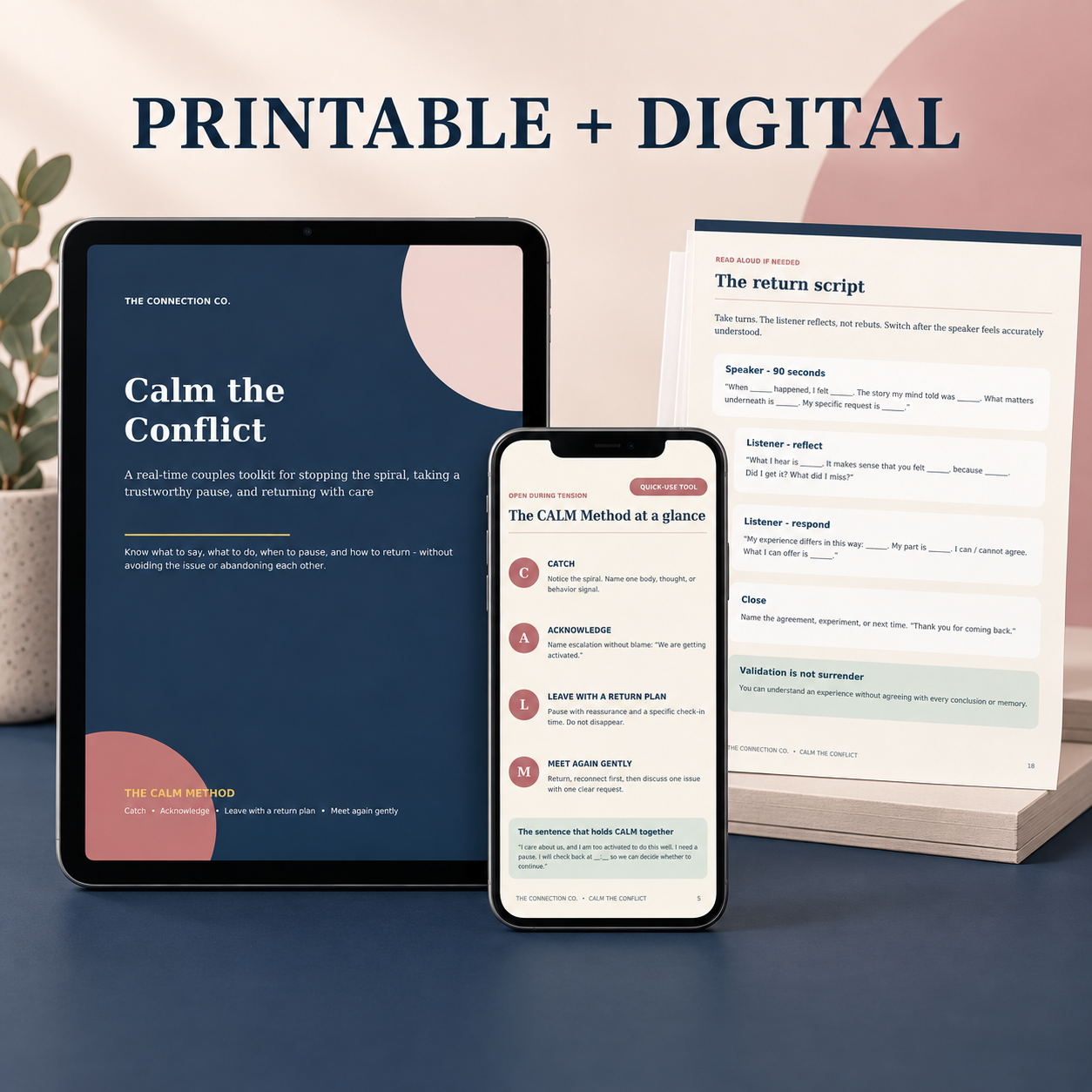
Calm the Conflict gives couples phone-friendly tools, scripts and step-by-step guidance for real-time tension.
What not to do when trying to calm conflict
- Do not demand that your partner calm down.
- Do not call a pause and disappear indefinitely.
- Do not use silence to punish or control.
- Do not insist on physical affection when the other person is not ready.
- Do not continue an exercise if either person feels unsafe.
A simple sentence to remember
When you cannot remember seven steps, use this: “I care about this, and I want to talk about it in a way that does not make it worse.” Then choose a slower pace, a smaller topic, and a clear return time if you need a break.
Two practical tools for different moments
If you need help while conflict is happening, explore Calm the Conflict: A Real-Time Couples Toolkit. If you want to work on the deeper recurring pattern over time, explore Break the Loop: A 14-Day Couples Conflict Repair Reset. They can be used separately or together.
Frequently asked questions
Is taking a break the same as avoiding the issue?
No. Avoidance has no clear return. A constructive pause names why you are stopping and when you will continue.
What if my partner refuses to pause?
You can state your boundary calmly: “I am not able to continue productively. I will return at 7:30.” Prioritize safety if the other person blocks you, follows you, threatens you, or uses intimidation.
Can these steps help every conflict?
They can support many ordinary disagreements, but they are not a substitute for crisis services, professional care, or safety planning when conflict involves violence, coercion, or fear.

Leave a Reply