

The silence after an argument can feel almost as difficult as the fight itself. You may want closeness but feel unsure how to begin. You may worry that apologizing will erase your perspective, or that revisiting the issue will start everything again.
Repair after a fight is not pretending nothing happened. It is the process of reducing emotional distance, taking responsibility for harm, and deciding how to return to what remains unresolved.
1. Make sure the conflict has actually cooled
Do not rush into repair only because tension feels uncomfortable. Check your body: Can you listen without interrupting? Can you hear your partner’s experience without immediately defending yourself? If not, agree on a return time.
2. Start with connection, not the case against them
Open with your intention: “I do not want us to stay disconnected,” or “I want to understand what happened between us.” This does not mean the issue is solved. It establishes that you are approaching each other rather than restarting the battle.
3. Take responsibility for your specific part
A useful apology names an action and its impact.
- “I interrupted you repeatedly.”
- “I used sarcasm when you were trying to explain.”
- “I left without telling you when I would return.”
Avoid “I am sorry you felt that way” or an apology followed immediately by “but you…” Accountability does not require taking responsibility for everything.
4. Ask what hurt most
The most painful moment may not be the one you expect. Ask: “What part of the argument stayed with you?” Listen for emotional impact, not only factual disagreement.
5. Reflect before explaining
Show your partner that you understood: “When I walked away without a return time, it felt like I did not care whether we resolved it.” Then ask whether your reflection is accurate.
Your explanation may matter, but understanding should come first. Otherwise the explanation can sound like an attempt to cancel the impact.
6. Make one repair request
Repair is easier when each person knows what would help now. Possible requests include reassurance, quiet time, a hug with consent, a written plan, a do-over, or a scheduled follow-up.
7. Return to the unresolved issue separately
Emotional repair and problem-solving are related but distinct. You can reconnect first and schedule the practical decision for later. This prevents the apology from becoming another debate.
8. Decide what to do differently next time
Choose one observable change:
- Call a pause before voices rise.
- Use a return time.
- Discuss one issue at a time.
- Avoid serious conversations after midnight.
- Write requests down before discussing them.
Make repair easier to practice
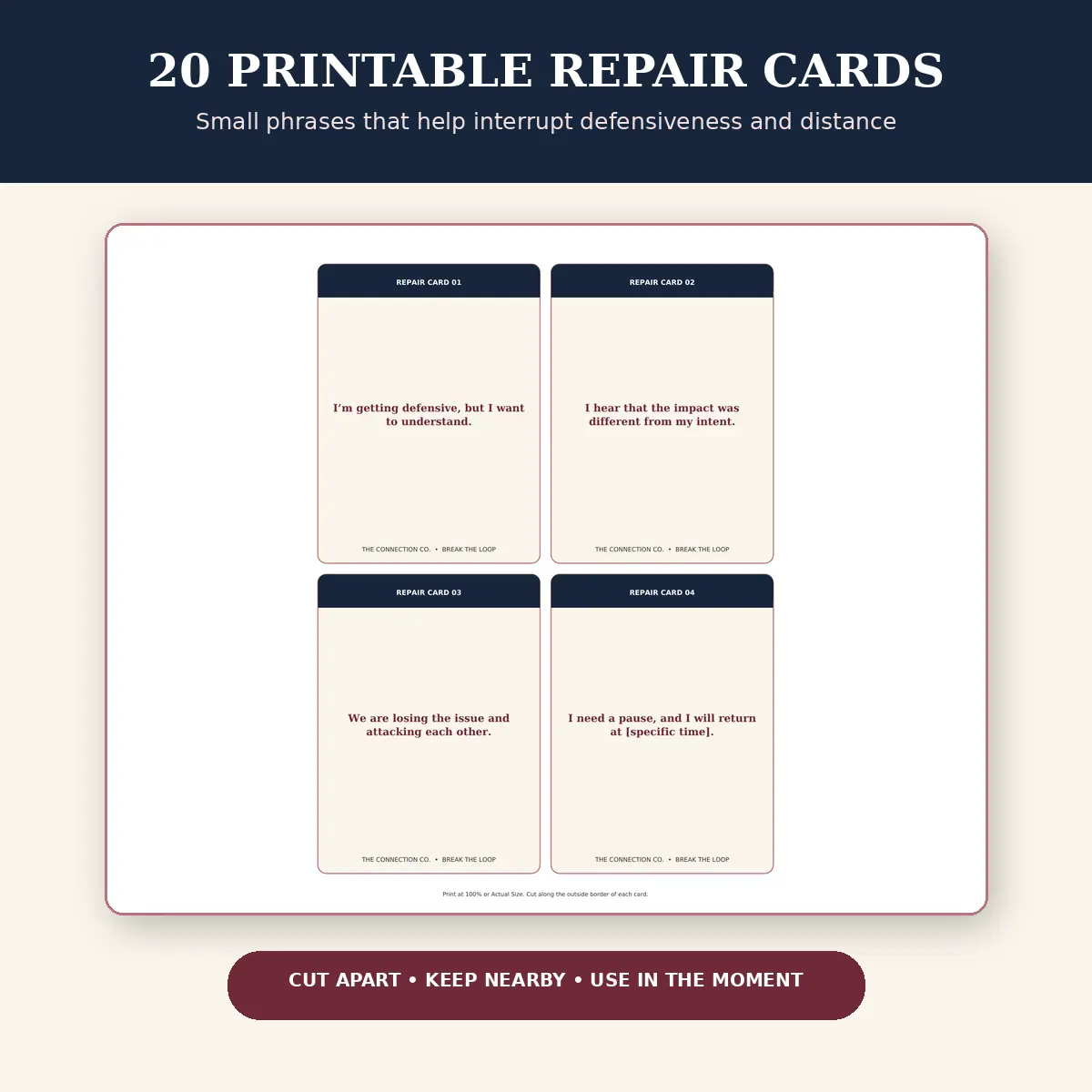
Break the Loop includes 20 printable repair-attempt cards, conversation scripts and a guided 14-day process for changing recurring conflict patterns.
What if your partner is not ready?
You can offer repair without demanding immediate acceptance: “I understand if you need more time. I am ready to talk when you are.” Then follow through. Do not use repeated messages, gifts, or physical closeness to pressure them.
Repair is not the same as reconciliation at any cost
Repair requires honesty and safety. It does not require overlooking repeated harm, abandoning boundaries, or remaining in a dangerous situation. Communication tools are not appropriate substitutes for safety planning or specialized professional support.
Two practical tools for different moments
If you need help while conflict is happening, explore Calm the Conflict: A Real-Time Couples Toolkit. If you want to work on the deeper recurring pattern over time, explore Break the Loop: A 14-Day Couples Conflict Repair Reset. They can be used separately or together.
Frequently asked questions
Who should apologize first?
The person who is ready to take responsibility can begin. Starting repair does not mean accepting all blame.
What if we remember the argument differently?
Focus first on each person’s emotional experience and the behaviors you can verify. You do not need identical memories to acknowledge impact.
Can repair happen by text?
A short text can reopen connection or schedule a conversation. Complex accountability is usually clearer when both people have enough space to respond thoughtfully.

Leave a Reply