

Many couples argue about the same subjects—chores, money, phones, time, sex, parenting, or family boundaries—without ever feeling finished. The details change, but the emotional sequence remains familiar.
Recurring conflict does not automatically mean a relationship is doomed. It often means the couple is responding to a predictable loop without seeing the whole pattern clearly enough to change it.
The topic is not always the pattern
The visible topic might be dishes. The deeper pattern may be: one partner notices an unfinished task and interprets it as a lack of care; they criticize. The other hears the criticism as evidence that nothing they do is enough; they defend or withdraw. The withdrawal increases the first partner’s fear of being alone with responsibility, so they pursue harder.
Now both people are protecting something important, but their protective reactions create exactly the disconnection they fear.
Four parts of a recurring conflict loop
1. The trigger
A trigger is the immediate event: a forgotten task, late arrival, distracted response, changed plan, or unmet expectation.
2. The meaning
The mind rapidly gives the event meaning: “I am not important,” “I cannot do anything right,” “I am alone,” or “I am being controlled.” The meaning may be more emotionally powerful than the event itself.
3. The protective reaction
People protect themselves by criticizing, explaining, fixing, withdrawing, becoming sarcastic, demanding reassurance, or shutting down.
4. The partner’s interpretation
Your protection becomes your partner’s trigger. One person’s withdrawal may feel like abandonment; the other person’s pursuit may feel like attack. The loop feeds itself.
Why solving the topic does not always stop the fight
You can create a chore chart and still repeat the loop if the emotional meanings remain invisible. Practical solutions work better when each partner also understands what the disagreement touches underneath.
Ask: “When this happens, what do I start telling myself about you, me, or our relationship?” Then ask: “What do I do to protect myself when I believe that?”
How to map your loop without assigning a villain
Write the sequence as neutral actions:
- Event
- My interpretation
- My feeling
- My protective reaction
- My partner’s interpretation
- Their protective reaction
- How the cycle repeats
Use “the loop” as the problem. Both partners are responsible for their behavior, but neither person needs to become the permanent villain in order to create accountability.
Interrupt the smallest possible moment
Do not wait until the argument reaches its most intense point. Choose one early interruption:
- Name the familiar pattern.
- Ask one clarifying question before assuming intent.
- State the softer feeling underneath anger.
- Make one concrete request.
- Pause with a specific return time.
Small interruptions matter because the loop is built from a sequence. Change one link and the next reaction is no longer inevitable.
Ready to work on the pattern for 14 guided days?
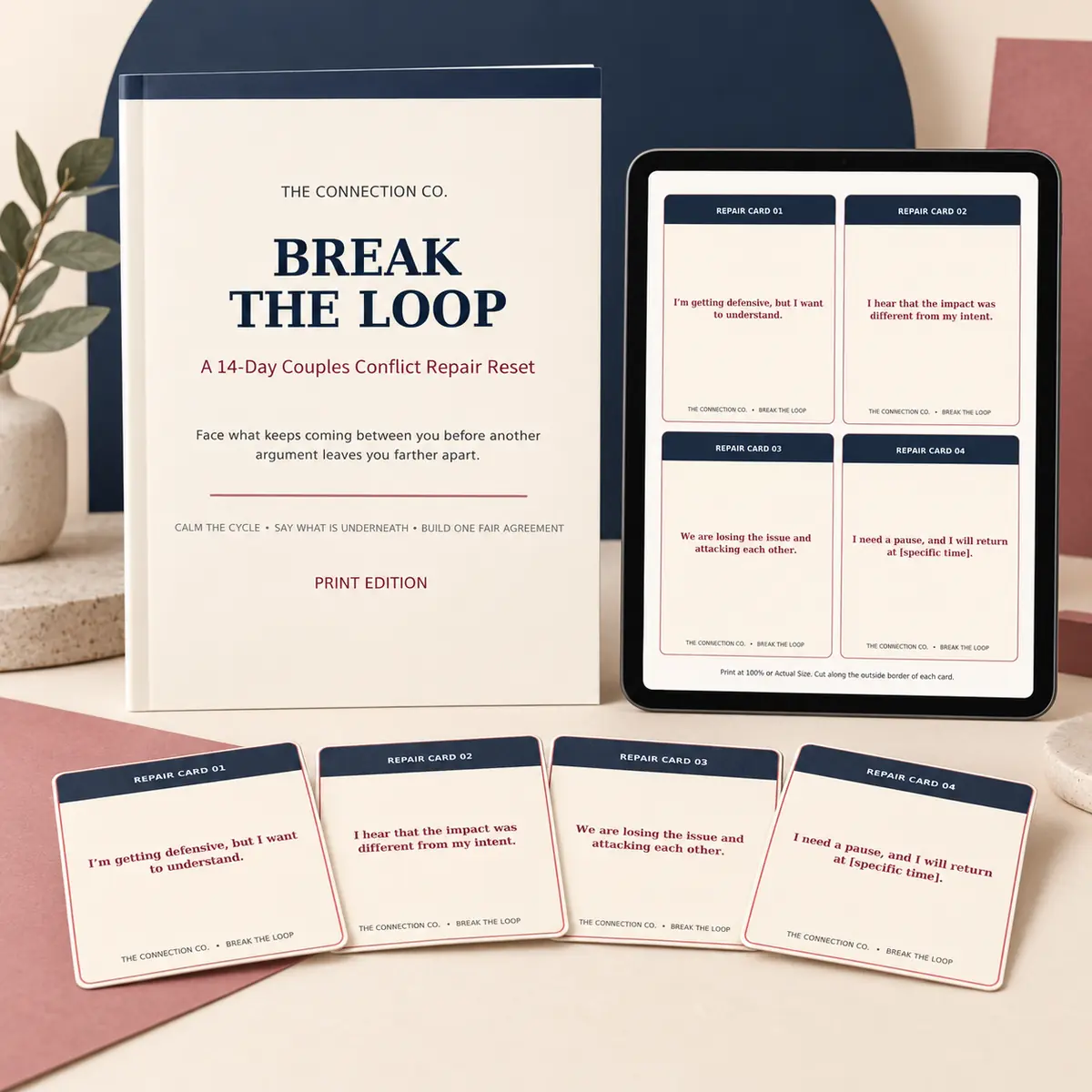
Break the Loop helps couples map recurring conflict, practice believable repair attempts and build a calmer path back to connection.
What progress actually looks like
Progress may not mean never arguing about the topic again. It may mean recognizing the pattern sooner, using fewer hurtful words, recovering more quickly, or making a repair attempt before both people shut down.
Track the quality of the process, not only whether the disagreement exists.
When a recurring pattern needs outside support
Consider qualified professional help when conflict remains intensely distressing, when either person cannot participate without becoming overwhelmed, or when the issue involves trauma, addiction, major betrayal, legal concerns, or mental health needs. If there is violence, coercion, stalking, intimidation, or fear, prioritize safety and specialized support.
Two practical tools for different moments
If you need help while conflict is happening, explore Calm the Conflict: A Real-Time Couples Toolkit. If you want to work on the deeper recurring pattern over time, explore Break the Loop: A 14-Day Couples Conflict Repair Reset. They can be used separately or together.
Frequently asked questions
Why do we fight about small things?
Small events can carry large meanings about care, reliability, fairness, freedom, or belonging. The emotional meaning often explains the intensity.
Can one partner change the loop?
One person can change their own response and influence the pattern, but a healthy shared repair requires responsibility and willingness from both people.
How long does it take to change a recurring argument?
There is no fixed timeline. Repetition, safety, accountability, and the complexity of the underlying issue all matter.

Leave a Reply